

Charting Hawaiʻi’s Path: Managed Retreat and Coastal Resilience
By Alice McLean (SSFM International), Ollie Lau (SSFM International)
As climate-driven coastal hazards escalate, managed retreat is emerging as an adaptation strategy that should be seriously considered for some of Hawaiʻi’s most vulnerable shorelines. Seeing a need to better understand the factors impacting coastal adaptation locally, the State Office of Planning and Sustainable Development (OPSD), Coastal Zone Management Program (CZM) commissioned a follow-up report to build on a previous managed retreat analysis from 2019. Completed in March 2025, An Analysis of Managed Retreat Strategies in Hawaiʻi: Policy and Funding Opportunities and Challenges sets out a comprehensive vision for proactive, equitable, and sustainable managed retreat as a tool in the climate adaptation toolbox for Hawai‘i. Below, we provide five central takeaways from the report with practical implications for planners, policymakers, and community leaders.
1. Managed Retreat: A Localized Decision That Should Be Made Within a Larger, Transparent Planning Framework
The purpose of this report is to guide future state initiatives around managed retreat as an adaptive response to climate change induced coastal hazards including sea level rise, erosion, and flooding. Managed retreat is defined as the strategic relocation of structures and redirection of future development away from areas subject to coastal hazards including erosion, flooding, and sea level rise. This report and its 20 recommendations propose, as a starting point, to focus strategies for managed retreat on sandy beach areas where retreat is likely to be a key adaptation strategy due to accelerating coastal erosion; where high value ecological, cultural, and recreational public trust resources exist; and where the consequences of not adapting proactively pose great risks to the public trust as well as public health and safety. Although the report focuses on sandy beaches, the findings can be applied to other areas where managed retreat could be applicable, such as eroding bluffs or pali.
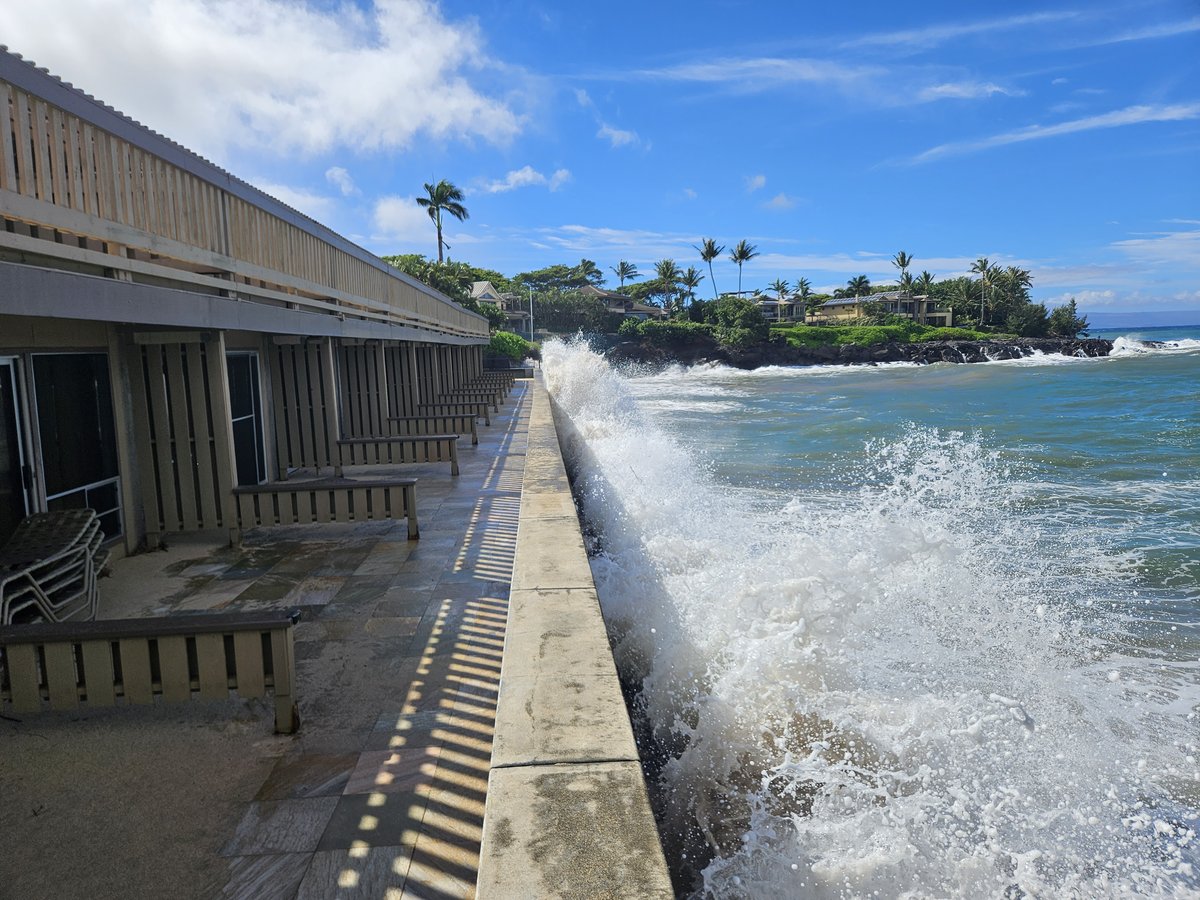
Retreat may be considered for areas experiencing severe coastal hazards, such as Kahana Sunset Building F in West Maui, November 2023 (Photo Credit: SSFM)
Decades of building too close to the ocean have left many of Hawaiʻi’s beaches and the cultural, environmental, and recreational resources they support at risk of permanent loss due to accelerating sea level rise and coastal erosion. Inaction or reliance on shoreline armoring has led to the disappearance of an estimated 25 percent of beaches on Oʻahu, Maui, and Kauaʻi over the past century. The report frames adaptation of coastal development as a vital tool for ensuring public shoreline access for future generations. The urgency for planning is underscored by the recent collapse of houses in Paumalū (Sunset Beach) on Oʻahu and the condemnation of one of the buildings at the Kahana Sunset condominium in West Maui.
The report acknowledges that the decisions on if, where, when, and how to retreat will ultimately need to be made on a localized scale. This decision-making should occur as part of a larger framework for coastal adaptation that includes scientific study of physical landscapes and natural processes, in-depth community and stakeholder engagement, and analysis of potential solutions and strategies to arrive at a pathway for adaptation that is based on site-specific conditions and needs. This adaptation pathway should be implemented as part of a larger program that clearly communicates risks, options, and incentives to affected parties and strikes an acceptable balance between adapting development and infrastructure, mitigating risks, protecting the public trust, and preserving public health and safety.
The report advocates a phased, regionally appropriate approach that can anticipate and address risk before infrastructure and communities are left in crisis.
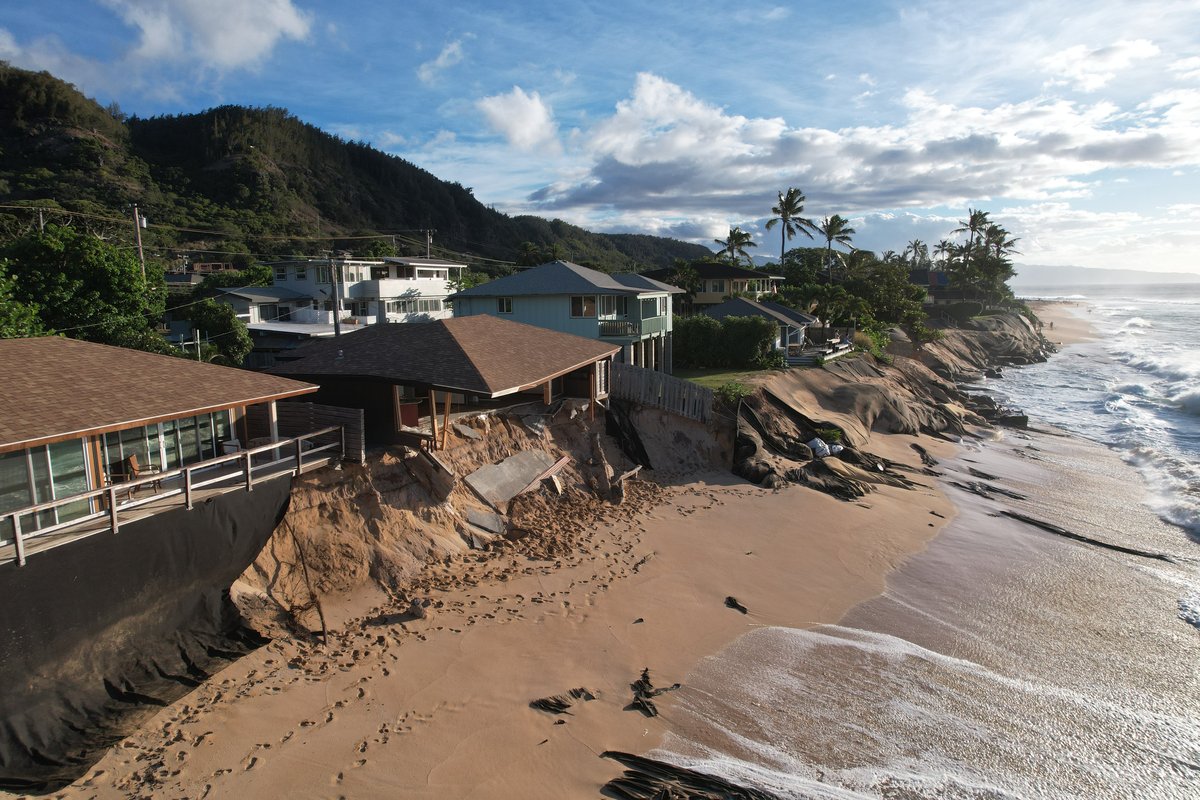
A house collapses onto the beach near Sunset Beach on the North Shore of O‘ahu, September 2024 (Photo Credit: Rob Waler/Integral Consulting)
2. The Beach Resilience Program: Place-Based Planning and Knowledge Integration
At the heart of the report is the proposed Beach Resilience Program (BRP), focused on adaptation of the built environment near eroding sandy beaches, including managed retreat of imminently threatened areas. This program would be designed to enable localized, science-based adaptation planning within priority sandy beach areas identified as BRPAs (Beach Resilience Planning Areas).
The BRP framework emphasizes:
- Adaptation Pathways: These are flexible, phased strategies for each BRPA, based on triggers (such as defined erosion thresholds or other observable phenomena) that cue specific responses (e.g. beach restoration, regulatory action, voluntary relocation). The pathways model allows for monitoring and adjustment as conditions change, supporting adaptive management.
- Community Engagement: Emphasizes meaningful involvement of residents, businesses, and landowners through structured processes for outreach, education, and collaborative visioning.
- Traditional Ecological Knowledge (TEK): Integrating Native Hawaiian knowledge systems and resource management practices enables more culturally rooted and ecologically aligned solutions. TEK is not only seen as a historic legacy, but as vital contemporary guidance for climate adaptation. TEK offers an opportunity to reframe managed retreat from a narrowly focused problem impacting private property to an opportunity to reimagine our relationship to coastal spaces that is more closely aligned with stewardship and the protection of the public trust.
- Site-Specific Conditions and Needs: Planning should be informed by up-to-date coastal erosion mapping, sea level rise projections, scientific modeling, and expert analysis, ensuring that recommendations are robust and relevant to each area’s unique challenges.
The report demonstrates how the BRP could operate by hypothetically applying recommendations to two case study areas: Sunset Beach (North Shore, Oʻahu) and the Kahana Sunset Condominium Building F (West Maui). Under the proposed framework, those living in identified risk zones would be notified long before imminent danger, and clear, transparent triggers would define when action is needed.
3. Grounding in Law and Policy: The Public Trust Doctrine and Regulatory Innovation
One of the most persistent barriers to managed retreat, both in Hawaiʻi and globally, has been legal uncertainty, especially regarding property rights and compensation. The report finds that Hawaiʻi is uniquely well-positioned to address these concerns due to the robust legal foundation provided by the state’s public trust doctrine, enshrined in the Hawaiʻi Constitution and further entrenched in HRS Chapter 205A. The public trust doctrine holds all public natural resources in trust for the benefit of the people, including nearshore coastal waters and lands up to the highest wash of the waves.
The proposed BRP and its purpose is grounded in Hawaiʻi’s well-established public trust doctrine, which constitutionally mandates the state to protect natural resources for the benefit of current and future generations. The report highlights that this doctrine, enshrined in Article XI, Section 1 of the Hawaiʻi Constitution and further codified in state statutes like HRS Chapter 205A, grants the state broad authority to manage and regulate coastal lands proactively to safeguard public trust resources. By explicitly aligning the BRP’s phased retreat strategies, regulatory framework, and enforcement mechanisms with this robust legal foundation, the program anticipates and addresses concerns about property rights and regulatory takings. Moreover, the program incorporates transparent procedures, clear triggers for adaptation actions, and due process protections, which collectively help to minimize uncertainties and litigation risks. This legal basis, combined with regulatory clarity and procedural fairness, positions the BRP as a durable, defensible framework for managing retreat in a way that balances private interests with the imperative to protect both public health and the irreplaceable coastal environment of Hawaiʻi.
4. Implementation: Coordinated Governance, Sustainable Funding, and New Planning Tools
The report is clear that even the most thoughtful planning framework will fail without strong and sustained interagency coordination, unambiguous jurisdictional authority, and dedicated long-term funding sources.
Key implementation strategies include:
- Agency Roles and Governance: The BRP calls for identification of a lead authority with the power to designate BRPAs, enforce adaptation requirements, and coordinate among state and county entities. The report identifies three alternatives for this authority: (1) increased and improved interagency coordination, (2) establishing a new division under the Department of Land and Natural Resources (DLNR) as the lead authority, and (3) creating an entirely new state coastal management entity in the same vein as the California Coastal Commission.
- Sustainable Funding: Establishment of a dedicated Beach Resilience Fund (BRF) is central, with proposals to use revenues from multiple avenues including the Transient Accommodations Tax (TAT), newly developed Special Improvement Districts under the BRPA, grants, and public-private partnerships to support voluntary relocation, restoration, and adaptation planning.
- Innovative Planning Tools: Conservation easements, buyout-leasebacks, transfer of development rights, and other financial incentives are identified as key tools for encouraging voluntary retreat in high-risk areas while facilitating recovery and redevelopment in suitable receiving areas. Identification of receiving areas was not part of the scope of this plan.
- Alignment with Land Use Plans: The BRP framework must be woven into existing state and county land use policies, shoreline setback requirements, and zoning codes to eliminate regulatory gaps and ensure consistent application.
This high level of coordination is necessary both to prevent piecemeal, reactive actions that undermine broader resilience goals and to ensure efficient use of limited resources.
5. Equity, Communication, and Community Engagement at the Forefront
Perhaps the most crucial lesson of the report is the necessity of advancing equity, transparency, and inclusive community engagement at every phase of climate adaptation, including the proposed BRP.
Key actions recommended include:
- Transparent Incentives and Triggers: The BRP is designed to clearly outline the types of incentives available (e.g., relocation packages, tax benefits, low-interest loans), who qualifies, and what regulatory triggers will activate different adaptation responses.
- Relocation Assistance: Dedicated funding and technical support must be provided to both property owners and renters. This is especially important for those in marginalized communities who may lack resources to adapt independently.
- Community-Driven Visioning: Outreach must go well beyond standard notice requirements to include workshops, culturally informed engagement, and empowered community advisory groups. This ensures that adaptation is shaped by the people most directly affected, and not just imposed from above.
- Prioritizing Social and Cultural Values: Planning must account for more than physical risk and property values—it must explicitly consider impacts on access to cultural, historic, subsistence, and recreational resources, with special care for Native Hawaiian communities.
The report reinforces that “meaningful community participation, clear communication about options and obligations, and accessible support for vulnerable groups are keys to building resilient, sustainable coastal communities.”
Conclusion: Toward a Resilient, Adaptable Coastal Future
An Analysis of Managed Retreat Strategies in Hawaiʻi is a call for transformation in how the state responds to present and future climate risks. The plan envisions managed retreat as part of a larger community-driven planning process that protects public trust resources and advances equity through transparent, collaborative, and science-based adaptation and land management.
Planners and decision-makers are urged to view the report not as a prescriptive end point, but as a detailed playbook for evolving laws, practices, and relationships to align Hawaiʻi with the realities of a changing climate. Whether on the North Shore of Oʻahu, West Maui, or other eroding sandy shorelines across the state, putting these principles into action will lead to a more resilient Hawai‘i.
The 2025 report and executive summary can be found at the website below:https://planning.hawaii.gov/czm/ormp/ormp-action-team-project-on-the-feasibility-of-managed-retreat-for-hawaii/
This project was completed for the OPSD by a project team composed of SSFM International, Solutions Pacific, Schlack Ito, and Integral Consulting and funded using Federal funds under Award Nos. NA22NOS4190022 and NA22NOS4190065 from the National Oceanic and Atmospheric Administration (NOAA), U.S. Department of Commerce. The statements, findings, conclusions, and recommendations are those of the author(s) and do not necessarily reflect the views of NOAA or the U.S. Department of Commerce.